Google's new AI search and what it means for small business
If you run a small business and you've seen the headlines about Google "changing search forever," you'd be forgiven for feeling a small wave of dread. Another thing to learn. Another thing the experts will tell you you're doing wrong. Another reason to feel behind.
So let me get the most important bit out of the way first: you are not behind, and you don't need to panic.
I'm not an SEO expert but I need to keep on top of this stuff, so I do. What I am, is a marketing and customer experience strategist who has spent close to 30 years helping regional and local businesses get found and chosen by real people. This change matters to me, and to you, because it's not really just about SEO. It's about how people find you in the first place. And that's something every small business owner should understand in plain English, without the jargon.
So here's what's happened, what it means, and what's genuinely worth doing about it.
What did Google actually announce?
In May 2026, at its big annual event, Google announced the biggest change to its search box in more than 25 years.
For 25 years Google search has worked roughly the same way. You type a few words or a question and you get a page of links - some sponsored and some organic. You click one. Done. That's now fundamentally changing.
How does the new Google search work?
Here are some of the key features:
It lets people search using more than text. They can drop in a photo, a file, a video, even a tab they've got open, and ask about it.
It answers conversationally. Instead of a page of links, people often get a written answer pulled together by AI, and they can ask follow-up questions like they're chatting to someone.
It builds answers on the spot. Sometimes the page is generated specifically for that one person's question.
The plain-English version is Google is becoming less of a directory you scroll through, and more of an assistant that gives you an answer.
What are "Information Agents" and do I need to care?
This was the part that got everyone talking, so it's worth explaining simply.
Information Agents are little AI helpers that work in the background, around the clock, watching a topic for you and tapping you on the shoulder when something changes. Think of them as a much smarter version of the old Google Alerts.
Someone house-hunting can set one to watch for new listings. Someone tracking an industry can have updates surface before they go looking.
For most small businesses, this isn't something you need to do anything about today. But it tells you where things are heading - people are going to lean on AI to keep an eye on the world for them, rather than searching for it themselves.
Okay, but what does this mean for my business?
Here's the honest bit, and it's the part the scary headlines tend to skip.
When Google hands someone a ready-made answer, fewer people click through to websites. That's real, and for businesses that have relied purely on ranking high in a list of links, it's a genuine shift.
But the question underneath it all hasn't changed at all. When that AI answer gets written, it has to decide who to mention. Which business to point to. Which source to trust. Which website is genuinely helpful enough to quote.
So the game isn't "be the top blue link" anymore. The game is "be the business the answer recommends.”
And that's actually good news for a lot of small, local businesses, because being trusted and genuinely useful is something you can build. It's not a technical trick.
Here's the part nobody's panicking about
Around the same time as all the dramatic announcements, Google quietly published a guide on how to show up well in this new AI-powered search. (You can read it here if you want the source.)
The takeaway from that guide? You don't need a whole new skill set. You don't need a separate "AI strategy." The fundamentals still matter, and most of the trendy AI hacks doing the rounds are a waste of your time.
Google's clearest instruction was basically to make pages for your actual audience, not for the robots.
If you've ever felt out of your depth with the technical side of marketing, read that line again. The thing that wins is the thing you're already closest to - knowing your customers and being genuinely useful to them.
So what hasn't changed?
This is what I'd hold onto:
People still trust businesses that other people trust. Reviews, word of mouth, being mentioned around your community and your industry. That all feeds into what AI decides to recommend.
Useful still beats clever. A page that actually answers the question a real customer is asking will always do better than a page stuffed with keywords.
Being specific and local is a strength. Generic content is exactly what AI can already produce on its own. Your real, grounded, on-the-ground knowledge of your customers and your place is the thing it can't make up.
What should you actually do? (no jargon, I promise)
You don't need to overhaul everything. Pick a few of these and do them properly.
Sort out your Google Business Profile. This is the free listing that shows up with your hours, location, photos and reviews. Make sure it's complete, accurate and up to date. For local businesses, this is still one of the highest-value things you can do, and it directly feeds AI answers about who to recommend nearby.
Answer the questions your customers actually ask. Not the questions you wish they'd ask. Write them down, the real ones, the slightly awkward ones, the "is it safe / how much / how long / do you come to my area" ones, and answer them clearly on your website. AI search is built around questions, so a website that answers real questions plainly does well.
Sound like a human being. Write the way you'd explain something to a customer across the counter. Both real people and AI now reward content that reads as genuine, specific and helpful, and they're getting better at spotting the bland, robotic stuff.
Show your proof. Real examples, real results, real local detail. The things only your business could write. This is what makes you a credible source worth pointing to.
Don't chase the gimmicks. There's already a flood of "AI optimisation" tricks being sold. Google's own guidance was clear that most of them don't help. Save your money and your weekends.
The bottom line on Google’s new search
Search methods changing isn't a new thing, it's been shifting for as long as I've been doing this work. What's different this time is the size of the shift, and the fact that it rewards exactly the things small, local, community-rooted businesses are naturally good at - being trusted, being specific, and being genuinely helpful.
You don't need to become an SEO expert. You need to be findable, credible, and clearly the kind of business a real person, or an AI answering on their behalf, would happily recommend.
Do less. Connect more. That's not just a catchy slogan, it’s the foundation for all my strategy, and it's just become the smartest thing you can do for how you get found.
Want a hand working out what this means for your specific business? Please get in touch, I’d love to help.
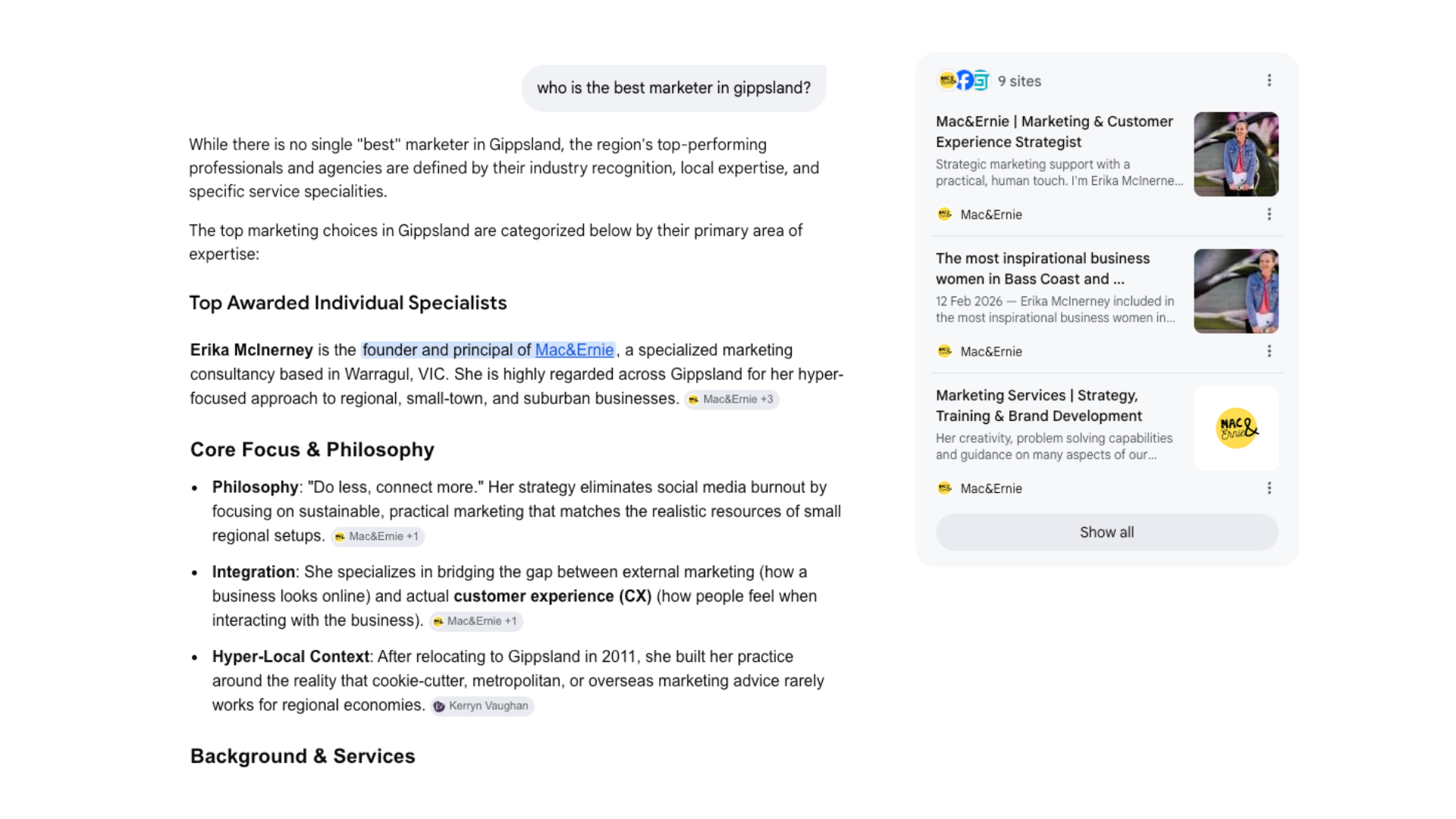
Go and check out what AI says about your business - you might be surprised

Hi, I’m Erika McInerney - a marketing and customer experience strategist working with regional, suburban and small-town businesses.
I help you see where customers and revenue are leaking, build practical marketing strategies around your real capacity, and create systems that actually support your business (and your life).
Alongside one-on-one work, I partner with councils, business groups and organisations to deliver practical workshops that build marketing capability across entire communities.
If you’re ready for clearer strategy and more confident visibility, you can book a free discovery call or send an email.